
SURAKARTA – Sido Mukti batik, the game of congklak, and sweet martabak. All three may sound unfamiliar in a mathematics classroom—but in the hands of Mathematics Education students at the University of Muhammadiyah Surakarta (UMS), the richness of local culture has become a captivating learning medium for a visiting lecturer from the Philippines.
The UMS Mathematics Education Study Program held a Visiting Lecturer event on Wednesday, June 10, 2026. The guest lecturer was Dr. Gemma F. Quintana from Aklan State University, Philippines—an academic who has studied contextual mathematics learning in Southeast Asia.
The event was opened by Sri Rejeki, S.Pd., M.Sc., Ph.D., the lecturer in charge of the Ethnomathematics and Realistic Mathematics course. In her introduction, she emphasized the importance of connecting student teachers with a global perspective to design relevant, meaningful, and contextual learning.
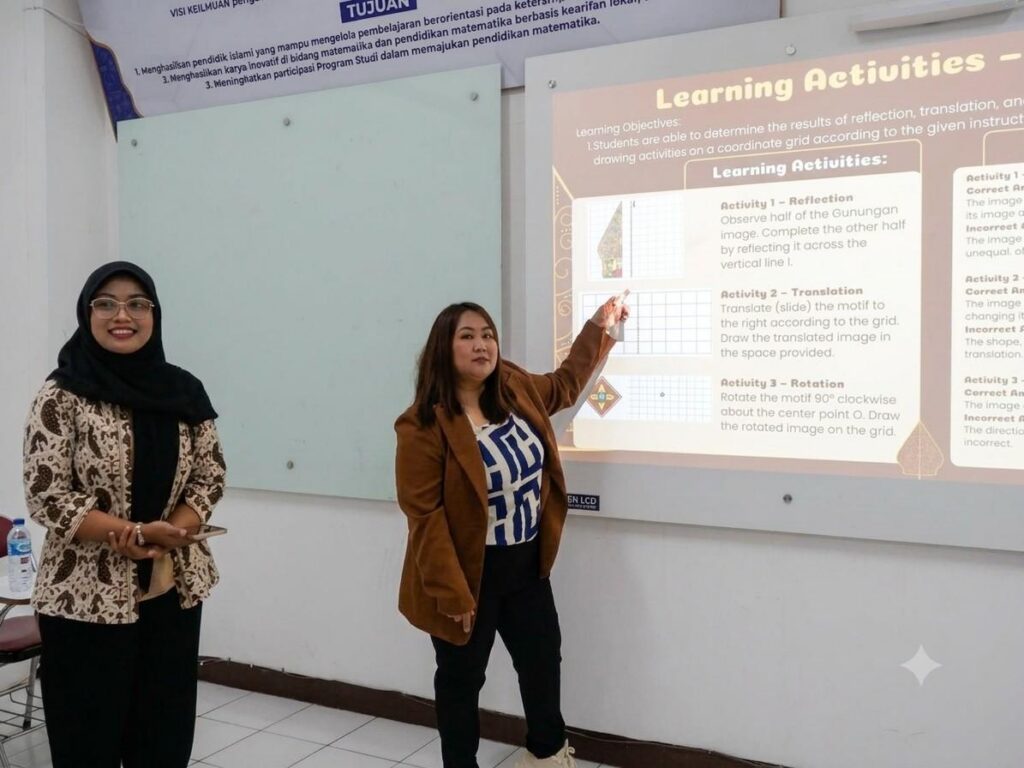
The main session served as a stage for three student groups to present their ethnomathematics-based learning model designs. Each group explored different cultural elements, but all focused on one goal: to make mathematics feel real and accessible to students.
The first group chose the Sido Mukti Ceplok batik motif—a typical Javanese motif steeped in philosophy—as the context for learning geometry for eleventh-grade students. Through exploring the batik motif, students were encouraged to directly recognize patterns, symmetry, and transformations of plane figures.
The second group incorporated the traditional game of congklak into learning about integers. The congklak pieces, moving from hole to hole, revealed rich concepts of addition and subtraction—something often overlooked from a formal mathematical perspective.
Meanwhile, the third group presented sweet martabak and layered cake as a bridge to understanding the concept of fractions. By dividing the cake sheets, students learned about numerators, denominators, and fraction operations in the simplest way: through foods they were familiar with.
Dr. Gemma listened attentively to each presentation. She appreciated the students’ sensitivity in choosing cultural contexts close to their daily lives. However, she also encouraged them to go further.
She believed that the lesson plan needed to be strengthened with provocative questions that encourage students to think critically. The exploration of mathematical concepts that emerge from culture also needed to be explored more deeply, not simply used as decoration. She continued, she added, that visual representations and learning activities needed to be more carefully aligned with the learning objectives to be achieved.
The discussion session was lively and interactive. Students enthusiastically asked questions and responded to feedback, making the forum more than just an evaluation—it became a space for cross-border collaboration.
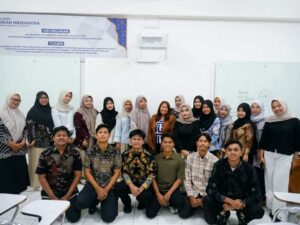
After the lecture, Dr. Gemma was invited to visit the display room and teaching aids workshop of the UMS Mathematics Education Study Program. This is where her deepest impression was made.
“I think that the mathematics education here is very innovative because you have this manipulatives laboratory that I don’t think I’ve seen in other programs, even in the Philippines. So, UMS is very innovative… when it comes to creativity, the mathematics education students here are truly creative.”
For Dr. Gemma, the teaching aids laboratory and learning media development workshop are a tangible reflection of UMS’s commitment to innovative mathematics education. She acknowledged that such facilities are not necessarily found in other universities, even in her own country.
Before concluding her visit, Dr. Gemma took the time to deliver a direct message to the UMS students—one that transcends academic boundaries.
“Yes, I think that when I met some of the students here at UMS, they were very nice and kind, but I think they have a lot of talent and potential. They also have a lot of great professors and lecturers, and my advice to them would be to be more confident and go out there, change the world, transform education because I believe they can do it well.”
Those words were warmly received. Confidence, for Dr. Gemma, is not just about performing in front of the class—it’s about having the courage to bring fresh ideas to the wider world of education.
This Visiting Lecturer activity is not just a ceremonial event. For the UMS Mathematics Education Study Program, it is a concrete manifestation of its commitment to bringing students closer to global conversations about mathematics education—without abandoning local cultural roots.
By integrating ethnomathematics into the curriculum and opening up dialogue with international academics, UMS proves that quality education doesn’t have to turn its back on tradition. Quite the opposite—local culture can be a starting point for a deeper, more meaningful, and more humane understanding of mathematics.